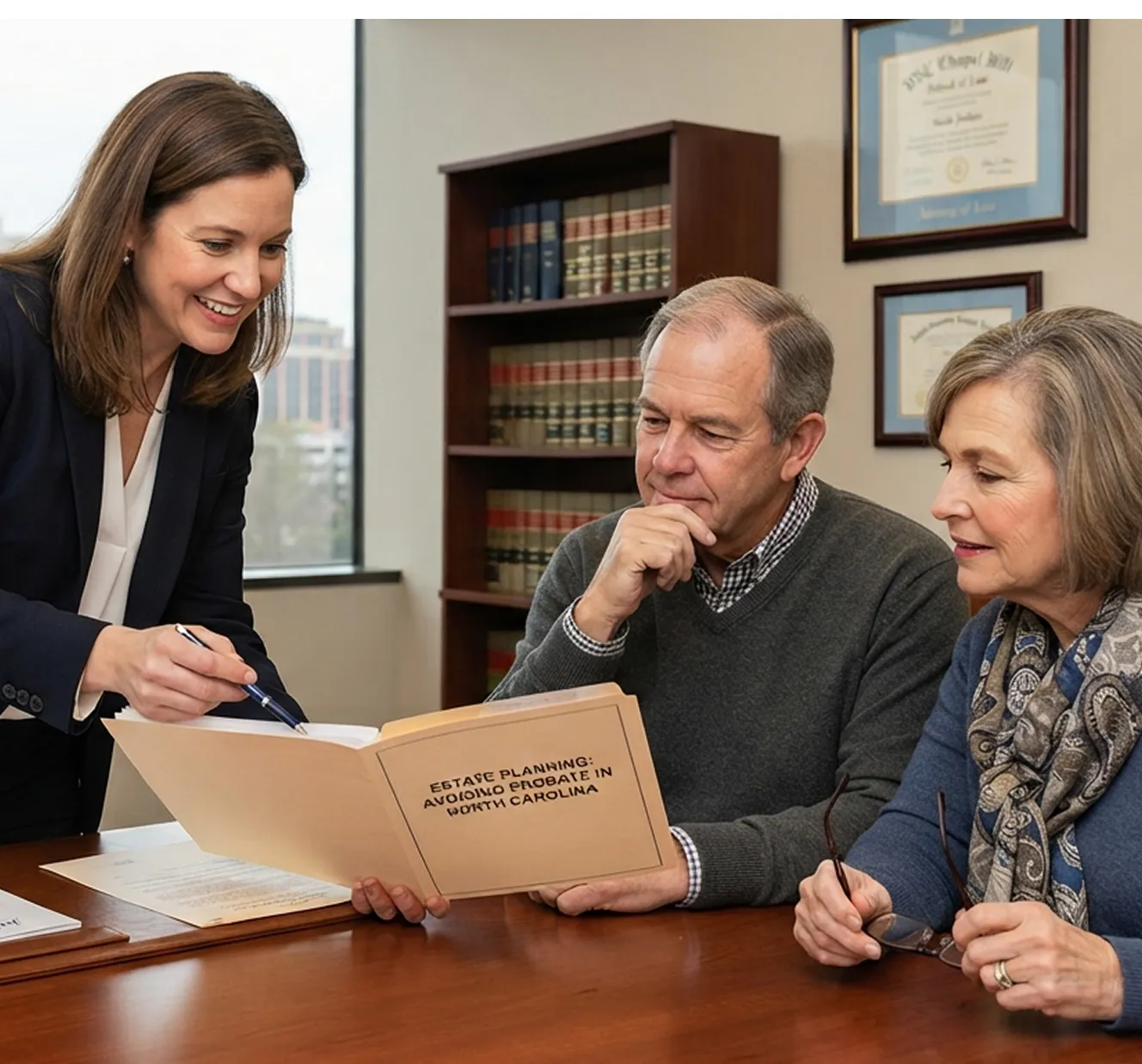
One of the most common questions people ask when planning their estate is, “Can my family avoid probate in North Carolina?”
The answer is that probate can often be reduced or simplified, but whether it can be avoided entirely depends on the type of property you own, how your assets are titled, and the planning you complete during your lifetime.
An experienced estate planning law firm in North Carolina can help you understand which options may work for your situation.
What Is Probate?
Probate is the legal process of administering a deceased person’s estate. Depending on the circumstances, probate may involve:
- Validating a will.
- Identifying and valuing assets.
- Paying valid debts and taxes.
- Transferring property to heirs or beneficiaries.
Not every asset passes through probate. Many assets transfer automatically by operation of law or by beneficiary designation.
If you need help understanding this process, a probate administration lawyer in North Carolina can explain what may apply to your estate.
Which Assets Usually Avoid Probate?
Certain assets commonly pass outside probate, including:
- Life insurance proceeds payable to a named beneficiary.
- Retirement accounts with designated beneficiaries.
- Payable-on-death (POD) bank accounts.
- Transfer-on-death (TOD) investment accounts.
- Assets held in a properly funded revocable living trust.
- Property owned jointly with rights of survivorship, when applicable.
In North Carolina, real property, such as structures or land, passes outside of probate except in a narrow set of circumstances.
More details can be found in related articles,
- We Inherited Land Together
- My Siblings and I Inherited a House
- Dad Promised I would Inherit the Family Farm
- What Happens if I Die without a Will in North Carolina?
Each type of asset has its own legal rules, and proper planning is essential.
Can a Living Trust Help?
A revocable living trust is one of the most common probate-avoidance tools.
When assets are properly transferred into the trust during your lifetime, they can often be managed and distributed by the successor trustee without going through the probate process.
However, simply signing a trust agreement is not enough. The trust must be properly funded by transferring appropriate assets into it.
CW Lachey Law offers a Trust Transfer Service to ensure proper funding of your Revocable or Irrevocable Trust.
What About My Home?
Your home may or may not pass through probate depending on how it is titled.
For example, ownership with survivorship rights may allow property to pass automatically to the surviving owner; this is usually when spouses buy real estate together during their marriage and the property is not otherwise subject to a Prenuptial or other private agreement between the spouses.
In other situations, the property may become part of the probate estate, such as when the last spouse dies with living descendants or a person dies with no spouse, no descendant, but with living siblings.
Because real estate is often a family’s largest asset, it is worth discussing ownership options with an estate planning attorney before making changes to a deed.
Common Misconceptions
“A Will Avoids Probate.”
No. A will generally directs how property should pass through probate. It does not eliminate the probate process.
“Probate Is Always Bad.”
Not necessarily. Many estates proceed through probate without significant difficulty.
In some situations, probate provides legal protections that benefit heirs and creditors alike. In our experience, the most common issues with probate are
- Court delays
- Creditor claims; and
- Overall costs of Probate vs. creating a Trust.
“Adding My Child to My House Is Always the Best Way to Avoid Probate.”
Not always. Adding another owner to your property can create unintended legal, tax, financial, and creditor issues. What works for one family may create problems for another.
You may be subject to an unintended Partition action, your new co-owner may die without a will, further dividing their property interest, or you are stuck with an unwanted house guest.
Should You Try to Avoid Probate?
That depends on your goals and circumstances, but avoiding or simplifying probate can make estate administration easier for your loved ones.
Some families prioritize privacy, which a trust can help provide. Others want to simplify the process for beneficiaries, especially when family disagreements could make estate administration more complicated.
Some people may also prefer to allow beneficiaries to handle certain costs from the estate they inherit.
Estate planning should be tailored to your circumstances rather than relying on one-size-fits-all advice.
Speaking with one of the top estate planning lawyers in North Carolina can help you understand which approach best fits your goals.
The Bottom Line
The right answer depends on what you own and what you are trying to accomplish.
Most families benefit from a trust; others do not need one by operation of North Carolina Intestate Succession. The important thing is making those decisions before they are needed.
We are an experienced estate planning firm and will review your assets, explain which property may pass outside probate, and recommend strategies that fit your family’s needs and long-term goals.